Nature’s Underwater Innovators: Sandcastle worms
Written by youth apprentice Maya N.
Abstract
In the rocky intertidal ledges of Cabrillo National Monument, the sandcastle worm weaves sand into living reefs, transforming the shoreline with thousands of shimmering miniature castles. This master builder not only glues sand underwater, it is a keystone of the local ecosystem and a source of innovation for science.
Introduction
The sandcastle worm (Phragmatopoma californica) is a segmented marine invertebrate known for its unique tube reefs (Bryant, 2006). Constructing hive-like shelters in colonies out of grains of sand glued together by a protein adhesive, these worms are important members of the intertidal ecosystem (Stewart et al., 2017). Scientists have become interested in the worm’s strong underwater glue, which can be used as an inspiration for synthetic adhesives in biomedical and engineering fields.
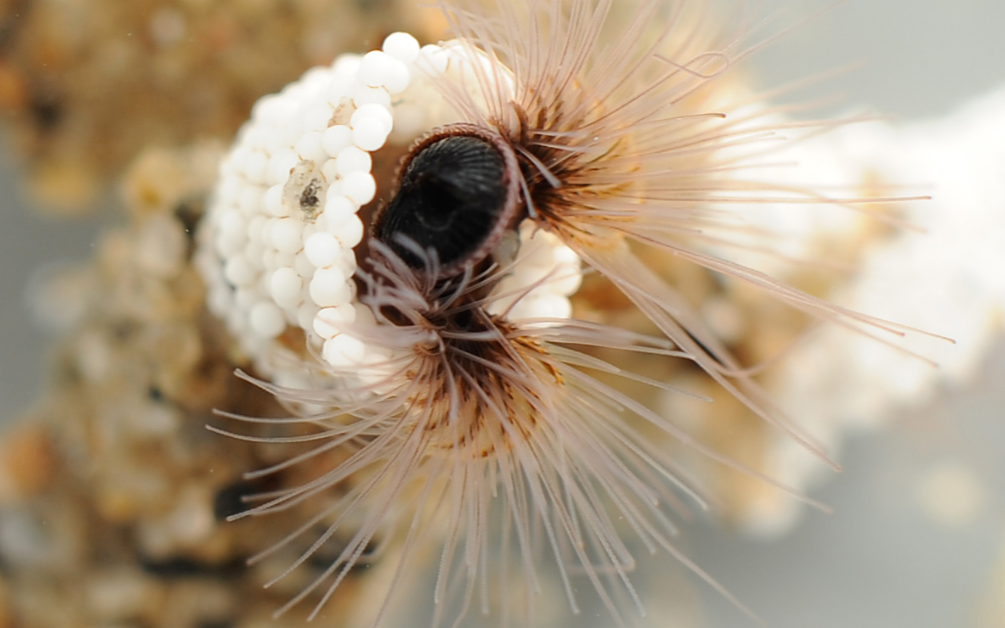
A sandcastle worm (Phragmatopoma californica) in the laboratory of Russell Stewart, University of Utah, making a tube out of sand (yellow) and beads of zirconium oxide (white).
Hidden in Plain Sight
The sandcastle worm, also known as the honeycomb tube worm, is a longtime resident of the rocky intertidal zone, where the ocean meets land between high and low tide. Life there is demanding: organisms are exposed to crashing waves, shifting temperatures, drying air, and changing salinity. These worms are found on the coast of California and Mexico, from Sonoma County to northern Baja California (Ricketts et al., 1985).
Picturing the Worm
The sandcastle worm reaches around two inches in length (U.S. National Park Service, 2021). This magnificent creature forms tubes of cemented sand grains that shield its delicate body. Instead of secreting its outer shell the way snails and clams do, the sandcastle worm scavenges the mineral parts of its shell from its environment — mainly bits of sand — and glues them together. Aggregating these tubes, worms build enormous colonies of honeycomb reefs (Stewart, 2010). The resulting structure can be thought of as a neighborhood of tube homes, with each worm settling in an individual tube.
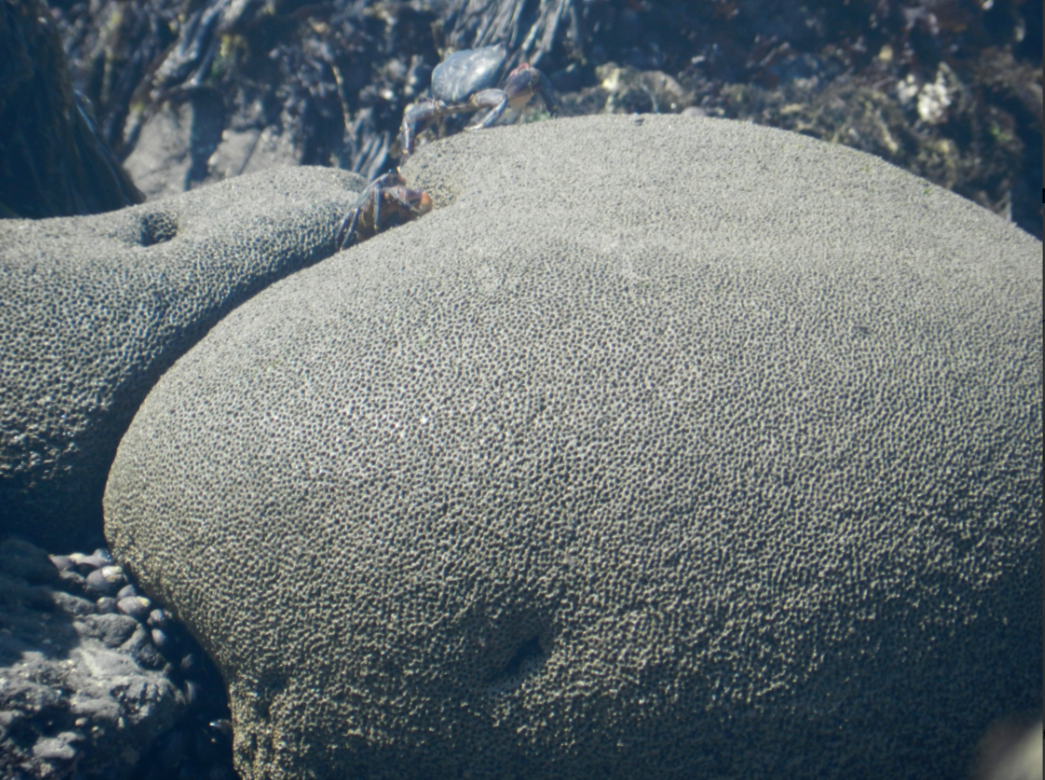
A rounded mound of sandcastle worm reef is visible in shallow water. The surface appears rough and grainy from cemented sand particles. The worms are not visible at this time. Several striped shore crabs are present and moving across the reef surface.
These structures of tubes, reminiscent of sandcastles, can be seen on rocky beaches during low tide. The tubes of these solitary polychaete worms form masses of up to two meters in length (Hinton, 1987). Polychaetes are a class within the phylum Annelida, which consists of segmented worms. Polychaete worms are primarily marine, living in ocean environments, and are characterized by their multi-segmented bodies. Sandcastle worm dwellings are often found in sheltered areas such as overhanging ledges and concave shorelines (Ricketts et al., 1985).
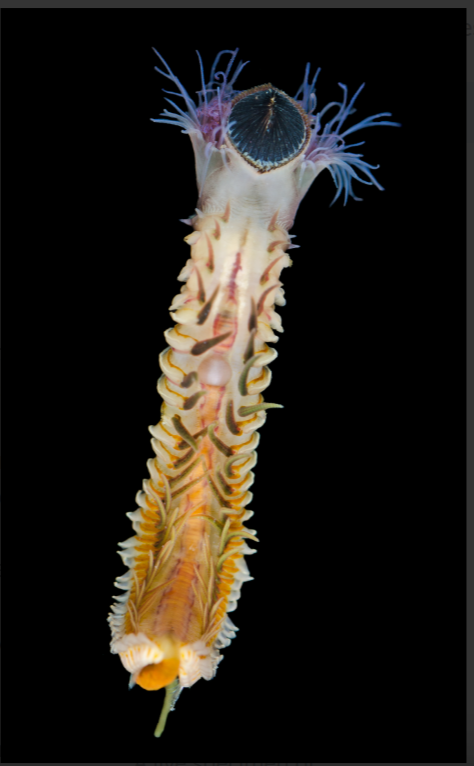
A California sandcastle worm (Phragmatopoma californica) is shown against a black background, its orange segmented body lined with small bristles. At the top, a fan of delicate blue and purple tentacles spreads outward for feeding.
When submerged, the worms stretch their crown of lavender tentacles from the safety of their tube into the open water to catch food and sand grains. Grains of sand are fed to the building organ behind their mouths. These particles are then examined by the building organ, and if found suitable, attached with a tiny dab of glue that hardens underwater within seconds. At low tide, when above the water, they close the entrance to their tubes with an operculum lid of dark setae (Hinton, 1987). The operculum lid acts like a trap door, made of stiff, dark bristles called setae, that the worm uses to seal the entrance to its sand tube. This protects it from predators and traps a small amount of sea water allowing it to continue breathing during low tide.
Home Life
Sandcastle worms are homebodies and go largely unseen. They feed off plankton and detritus which are common in the intertidal zone (Hinton, 1987). Their unique structures provide protection and habitat for small organisms, like sponges and other stationary sea creatures, helping to stabilize sediment and create small reef-like ecosystems (Stewart et al., 2017).
The distinct colonies are formed by the gregarious settlement of larvae, which require contact with an existing colony to metamorphose into adult worms. The communal settlement of this species has been linked to specific free fatty acids found in the tubes of adult worms. On rocky beaches, settlement depends on larval behavior in the water column and their ability to detect chemical cues when they come into contact with the adult tubes. This means larvae detect chemical cues made by adult worms, a signal to attach to the colony and settle down to become adults (Pawlik et al., 1991).
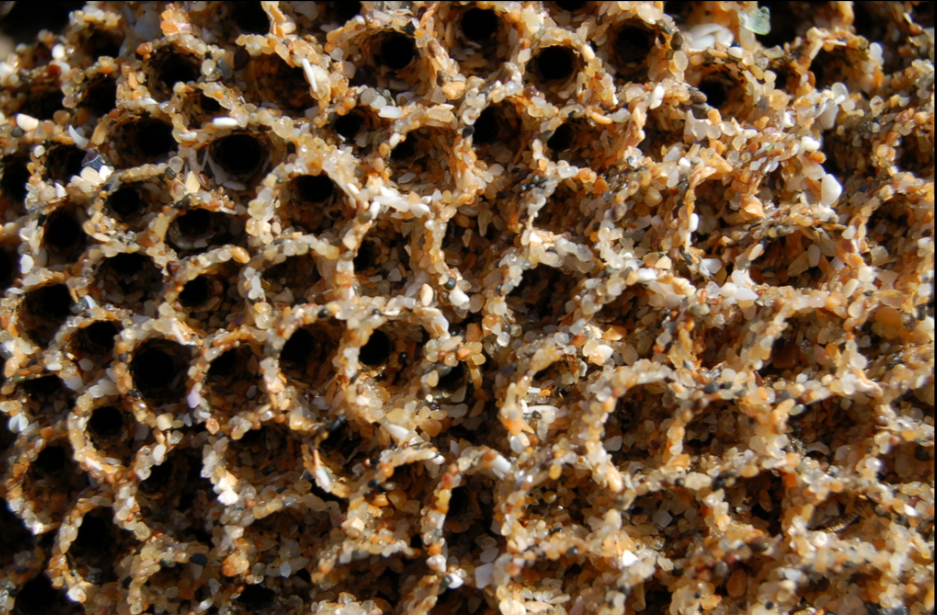
A close-up of a sandcastle worm colony reveals tightly packed sand tubes forming a honeycomb-like pattern. Each small circular opening is made of cemented sand grains, creating a rough, reef-like surface.
Living in the intertidal zone means surviving a harsh environment of strong waves and winds. A worm’s ability to build and repair under such conditions comes from its strong natural adhesive (Fernandez, 2016).
Gluing it All Together
This robust underwater adhesive is a protein-based glue able to withstand wet, salty, and turbulent conditions. Sandcastle worms, mussels, and other glue-secreting intertidal zone species inspire scientists and engineers to develop adhesives (Fernandez, 2016). In sandcastle worm-inspired glue, adhesion is streamlined through solvent exchange. A solvent is the liquid that dissolves or carries other substances within a mixture. During solvent exchange, the glue’s initial solvent is replaced by the surrounding water, which triggers a change in the glue’s chemical environment and causes the adhesive to rapidly solidify.
This glue mimics the porous sandcastle structure and is more resistant to cracking. This also improves wet adhesion. The result is a robust underwater adhesive useful for both biomedical and non-biomedical purposes such as tissue repair, dental adhesives, and surface adhesion applications required under adverse conditions like salty seawater or aqueous solutions containing organic impurities (Zhang et al., 2021).
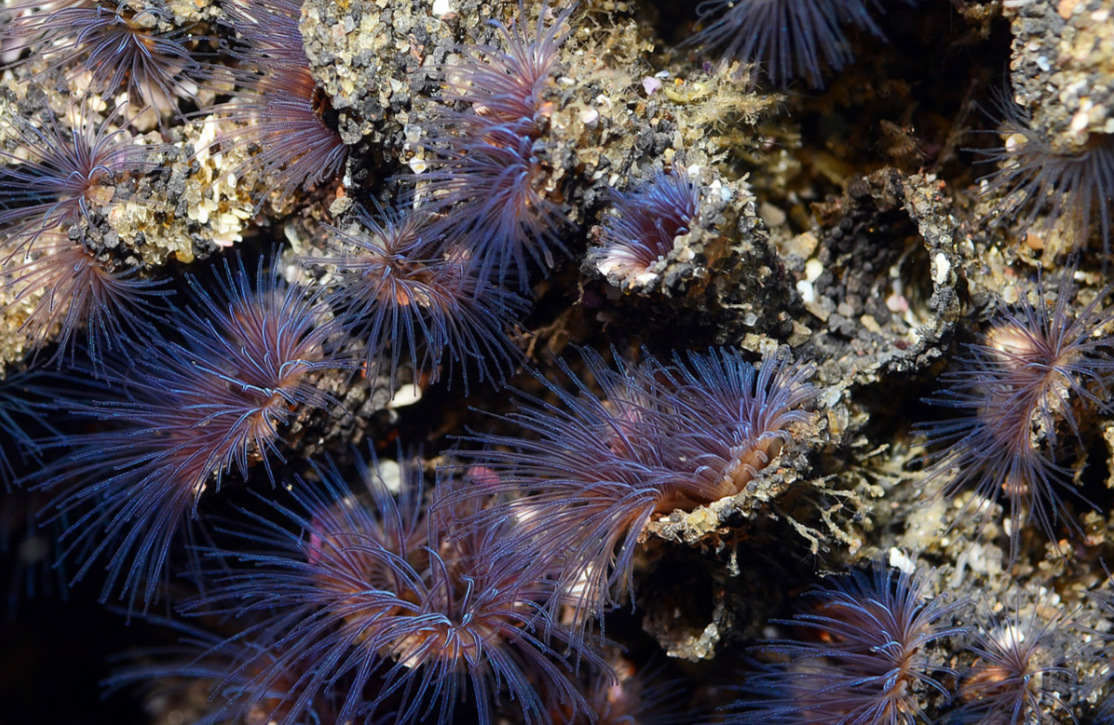
Multiple sandcastle worms are visible with their feathery, purple-brown feeding tentacles extended from their sand tubes. The tubes are clustered together, forming a reef structure attached to rock.
Since before 2016, researchers at UC Santa Barbara and other institutions have studied the chemistry of the worm’s natural glue (Fernandez, 2016). It contains alternating amino acids that promote cohesion.
In 2021, a Nature Communications study reported a sandcastle worm-inspired strategy to functionalize, or make something functional for a specific purpose, wet hydrogels. Hydrogels, jelly-like materials that can hold a lot of water, are frequently used in various fields, yet currently they require a multiple-step process to be functionalized. Taking inspiration from the sandcastle worm, researchers developed a one-step strategy to implement wet hydrogels. They were able to emulate the adhesive proteins secreted by the sandcastle worm when binding to wet mineral surfaces. This glue mimics the sponge-like structure of a sandcastle worm’s tube, which is filled with tiny holes. This design makes it more resistant to cracking and better at sticking in wet conditions. The result is a strong underwater glue that can be used for medical purposes, like repairing body tissues and dental work, as well as for bonding surfaces in harsh environments such as salty seawater or water containing organic impurities, natural materials like small bits of plants, algae, bacteria, or other living matter that can make sticking things together more difficult (Zhang et al., 2021).
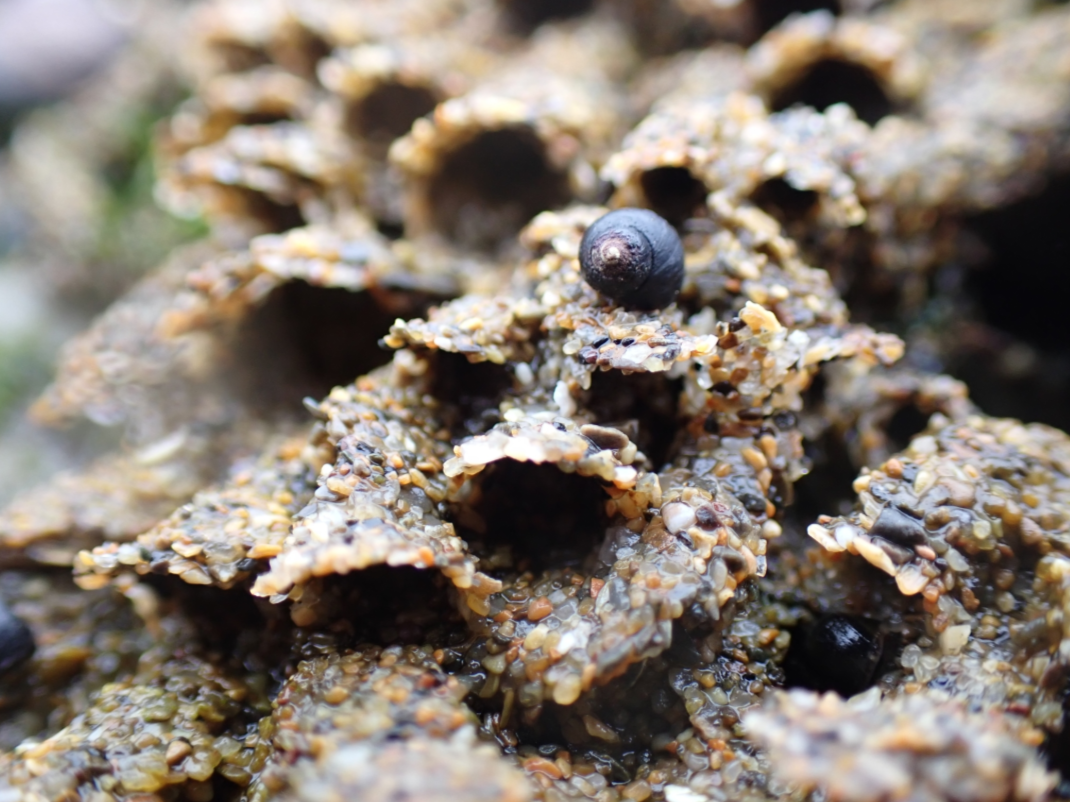
Close-up of empty and occupied sandcastle worm tubes made of cemented sand grains. Several dark, round snails are resting on the reef surface. The worm bodies are not visible in this image.
Conclusion
The sandcastle worm is an extraordinary marine invertebrate that thrives in the intertidal zone. By gathering sand grains, testing them, and gluing them together into strong tubes, it builds protective colonies that benefit both the worms and their ecosystems. The worm’s efficient construction techniques, unique behavior, and strong underwater adhesive have inspired scientists to create new synthetic glues and materials. These adhesives are now being developed for medical use, such as tissue repair and hydrogel enhancement. From coastal reefs to laboratory innovations, the sandcastle worm continues to influence both natural ecosystems and modern science. Protecting biodiversity and conserving species like the sandcastle worm is essential, as their loss could mean the disappearance of a spectacular creature of natural innovation that brin
Protecting biodiversity and conserving species like the sandcastle worm is essential, as their loss could mean the disappearance of valuable natural innovations that benefit both ecosystems and human society. Protecting biodiversity starts with each of us. We can support coastal conservation efforts, reduce pollution in our communities, and stay curious about the hidden innovators living along our shores. Take time to learn about your local intertidal ecosystems, share their stories, and help others see the value in small species that make a big impact. Explore your shoreline, ask questions, and support science that protects marine life. The next breakthrough in innovation might just be hiding in the sand.
References
Bryant, P. J. (2006, July 14). Sandcastle worm, Phragmatopoma californica. Natural History of Orange County, California. Retrieved December 1, 2025, from https://nathistoc.bio.uci.edu/Annelids/Sandcastle.htm
Burgess, D. (2020, August 25). Life’s a beach for the false sandcastle worm. Washington State Department of Ecology. Life’s a beach for the false sandcastle worm - Washington State Department of Ecology
elizabethbettenhausen. (2018, July 19). iNaturalist observation [Observation record]. iNaturalist. https://www.inaturalist.org/observations/14525775
evn. (2025, July 27). iNaturalist observation [Observation record].California Sandcastle Worm from Santa Cruz, CA, USA on July 27, 2025 at 09:01 AM by evn · iNaturalist
Fernandez, S. (2016, February 1). Cling-on warriors. The Current. Retrieved December 1, 2025, from https://news.ucsb.edu/2016/016421/cling-warriors
Hayes, F. (Photographer). (2008). Sandcastle worm in laboratory closeup [Photograph]. University of Utah. https://commons.wikimedia.org/wiki/File:Sandcastle_worm_in_laboratory_closeup.jpg
Hinton, S. (1987). Seashore life of Southern California: An introduction to the animal life of California beaches south of Santa Barbara (1st ed.). University of California Press.
kqedquest. (n.d.). Phragmatopoma californica [Observation record]. iNaturalist. California Sandcastle Worm (Phragmatopoma californica) · iNaturalist
Pawlik, J. R., Butman, C., & Starczak, V. R. (1991). Hydrodynamic facilitation of gregarious settlement of a reef-building tube worm. Science, 251 (4992), 421–424. https://doi.org/10.1126/science.251.4992.421
Ricketts, E. F., Calvin, J., Hedgpeth, J. W., & Phillips, D. W. (1985). Between Pacific tides (5th ed.). Stanford University Press.
U.S. National Park Service. (2021, May 21). Sandcastle worm. (2021, May 21). Retrieved December 1, 2025, from https://www.nps.gov/places/sandcastle-worm.htm
Stewart, R. J. (2010, April 12). Video: The sandcastle worm. The New York Times. Retrieved December 1, 2025, from https://www.nytimes.com/video/science/1247467564026/the-sandcastle-worm.html
Stewart, R. J., Wang, C. S., Song, I., & Jones, J. P. (2017, January 1). The role of coacervation and phase transitions in the sandcastle worm adhesive system. Advances in Colloid and Interface Science, 239, 88–96. Retrieved December 1, 2025, from https://doi.org/10.1016/j.cis.2016.06.008
uwkwaj. (2017, November 24). California Sandcastle Worm Phragmatopoma californica. [Observation record]. iNaturalist. California Sandcastle Worm from Anacapa Island, California on November 24, 2017 at 10:02 AM by uwkwaj · iNaturalist
Zhang, D., Liu, J., Chen, Q., Jiang, W., Wang, Y., Xie, J., Ma, K., Shi, C., Zhang, H., Chen, M., Wan, J., Ma, P., Zou, J., Zhang, W., Zhou, F., & Liu, R. (2021). A sandcastle worm-inspired strategy to functionalize wet hydrogels. Nature Communications, 12(1). https://doi.org/10.1038/s41467-021-26659-0
Youth Apprentice Maya N. is a member of the Science Communication Fall/Winter 2025 cohort. As a new apprentice, this was her first “Field Note”, an exciting milestone in her journey with the EcoLogik Institute!