When the Ocean Got Too Loud: The Impact of Noise Pollution on Gray Whales
Abstract
I remember the time when my family and I were visiting a gray whale (Eschrichtius robustus) overlook for my birthday. I observed gray whales gliding through the Pacific Ocean with ease. Observing these animals made me wonder how they communicated with each other in the noise polluted world we live in, so I set out to learn about whale communication and ocean noise. Human activities create an abundance of sound, a type of noise pollution that often drowns out communication between whales, making navigation and migration confusing. This led me to discover the ocean’s habitat was louder than I had imagined.
Introduction
The sea, a vast body of water with an array of waves, is alive with calls of marine life. It is home to countless animals, many of whom depend on sound to survive. Yet beneath those calls to one another lies loud human-made noise - ships and heavy machinery that drown out the sounds of animal communication. Among the marine life who are most affected are gray whales (Eschrichtius robustus), who rely on communication for migrations, navigating, and keeping their calves close. Noise pollution endangers gray whale survival by changing their behavioral processes, which can increase stress levels and changing routes through migration (Johnston & Painter, 2024). Gray whales who once communicated freely across quieter oceans, are now struggling to navigate and communicate with one another (Mozter, 2024).
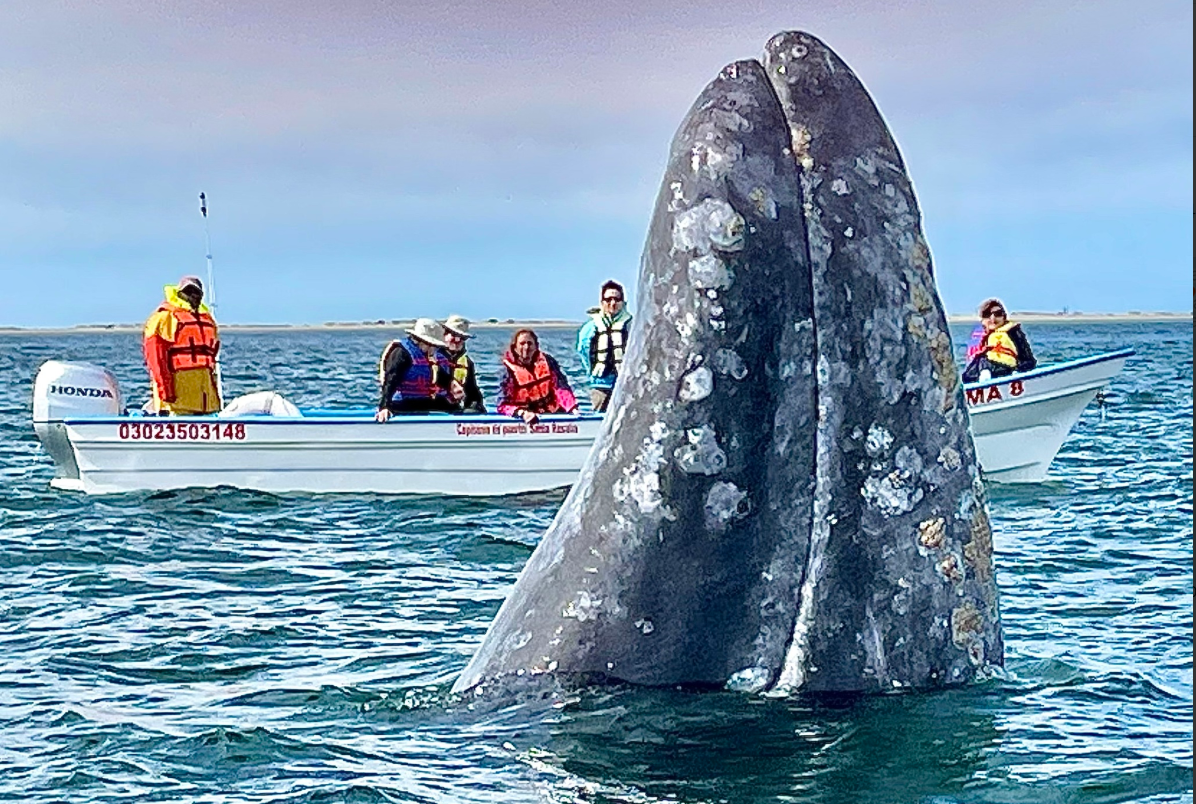
A close-up view of a gray whale rising vertically out of the ocean near a small boat carrying several people in bright life jackets. The whale’s large head, covered in white barnacle patches, emerges from the water while the passengers watch in awe.
Understanding the Effects of Ocean Noise on Marine Life
Gray whales are massive marine mammals that travel thousands of miles each year for migration. During these long periods of traveling, gray whales frequently use communication. These whales utilize low, deep frequency calls to communicate and find one another (Guazzo et al., 2019). Thus, the importance of this communication is to keep the family close during long migrations. But disturbance from ships interferes with this communication because of the low frequency noises of the engines that overlap with the same low frequency that gray whales make when communicating (Erbe, Dunlop, & Dolman, 2019). As a result of the engines masking the communication of the gray whales, it makes it harder for whales to detect danger or keep calves near (Johnston & Painter, 2024). Understanding these effects are crucial as these whales play a significant role in the ocean.
These gray whales help distribute and feed marine animals nutrients. The scooping movements these gray whales are using filter out sediments, kick nutrients into water columns, and prey from the sea floor. Noise pollution poses a serious threat for gray whales communication, navigation, and behaviors. As these noises continue, it contributes more and more to the decline of the gray whales’s population (Weilgart, 2007). While it isn’t the exact problem of the endangerment of gray whales, it is the most challenging problem for whales introduced by humans. “Human-wildlife interactions can cause negative outcomes at short and long-term scales, yet longitudinal monitoring of impacts of human activities on long-lived wildlife populations can be difficult, often requiring considerable resources and contextual individual-level information” (Lemos et al., 2022) . Humans are responsible for noise pollution that contributes to the decline of populations and it is our responsibility to reduce the noises. If we can maintain the balance of gray whale populations, we can ensure a better future for marine life and the oceans they depend on (Johnston & Painter, 2024).
I had a moment when I went with my family to observe gray whales. I was mesmerized by their movements in the water. But when a boat came too close to them, I could see how quickly they swam away, clearly startled by the sounds they were producing. At that moment, I felt a great pang of guilt, knowing that I, and other humans, contributes to noise pollution. Seeing this up close made me realize something: I never considered how much human-made noise could interfere with their swimming patterns and ability to communicate with one another. If I heard loud engines roaring on my way to school every day, I would feel just as disturbed as the gray whales. I will always remember that moment as I put those pieces together, a reminder that humans are responsible for challenges to wildlife like gray whales every day.
A Call to Protect Whale Communication and Marine Ecosystems
Just like humans, gray whales rely on communication to travel across the ocean safely. Unfortunately, human-made noises disrupt gray whale calls to one another, making navigation more difficult for them. Gray whales have such a great impact on other animals, spreading nutrients across the ocean floor - a system that’s also disrupted as gray whale populations decrease due to noise pollution effects. As humans, we contribute to noise pollution and need to take full responsibility for our actions. Even small steps, like supporting marine conservation organizations or learning about noise pollution, can help gray whales and other animals thrive beneath the waves.
References
aparrot1. (2024, February 10). Grey Whale (Eschrichtius robustus). [Observation record]. iNaturalist. Grey Whale from Boca del Surgidero, Mulegé, B.C.S., MX on February 05, 2024 at 11:50 AM by Irene. Crustaceans (Subphylum Crustacea) that live on skin of Gray Whales: Whale Lice (Cyamus scammoni)... · iNaturalist
Erbe C, Marley SA, Schoeman RP, Smith JN, Trigg LE and Embling CB (2019) The Effects of Ship Noise on Marine Mammals—A Review. Front. Mar. Sci. 6:606. doi: 10.3389/fmars.2019.00606
Guazzo, R.A., Weller, D.W., Europe, H.M. et al. Migrating eastern North Pacific gray whale call and blow rates estimated from acoustic recordings, infrared camera video, and visual sightings. Sci Rep 9, 12617 (2019). https://doi.org/10.1038/s41598-019-49115-y
Johnston, S.T., Painter, K.J. Avoidance, confusion or solitude? Modelling how noise pollution affects whale migration. Mov Ecol 12, 17 (2024). https://doi.org/10.1186/s40462-024-00458-w
Lemos, L.S., Haxel, J.H., Olsen, A. et al. Effects of vessel traffic and ocean noise on gray whale stress hormones. Sci Rep 12, 18580 (2022). https://doi.org/10.1038/s41598-022-14510-5
Mozter, P. (2024, April 10). Ambient noise pollution disrupts communication and navigation in whales, study finds. Nature World News. https://www.natureworldnews.com/articles/61300/20240410/ambient-noise-pollution-disrupts-communication-navigation-whales-study-finds.htm
Weilgart, L. (2007). A Brief Review of Known Effects of Noise on Marine Mammals. International Journal of Comparative Psychology, 20(2). http://dx.doi.org/10.46867/ijcp.2007.20.02.09 Retrieved from https://escholarship.org/uc/item/11m5g19h
Viev S. was a EcoLogik Institute youth camper back in the summer of 2023. Viev has been a youth apprentice since the Winter/Spring of 2025!